
I Thought, “Here We Go Again.”
A Personal Story About Feeling Dismissed, and Breaking a Familiar Pattern
My partner and I had gone away for the weekend to a riverside cabin surrounded by nature and lush greenery. It was supposed to be a break from routine. Just quiet, fresh air, and time together.
I had been looking forward to it all week.
Not because anything huge was planned. I just wanted uninterrupted time with him. The kind where you feel close again.
One afternoon, we were standing outside near the river, surrounded by trees and the kind of peaceful scenery that makes you think connection will happen naturally, and he got on the phone with his friends.
At first I thought it would be quick.
It was not.
I stood there waiting longer than I expected, trying not to make it a thing. But the longer it went on, the more alone I felt.
That was the part that stayed with me. Even in a place that was supposed to bring us closer, I still ended up feeling alone right beside him.

A riverside cabin weekend surrounded by nature and lush greenery becomes a moment of quiet relationship disconnection, as one partner feels alone while the other stays absorbed in a phone call.
Why I Finally Said Something About Feeling Ignored
Later, I decided to say it plainly.
Not accusingly. Not dramatically. Just honestly.
I texted him:
“I’ve actually been really upset about how we spent the weekend. When we were out in nature and you were on the phone with your friends, I felt really alone. I wanted to feel present with you.”
Even sending that made me nervous.
I was not picking a fight. I was trying to stop that familiar thing where I say nothing in the moment, carry it quietly, and then feel even worse later.
I wanted to say how it felt before it turned into resentment.
A Note From Communicat
We occasionally share personal stories from people who wanted their experience to be told.
This story is published with permission. A few identifying details have been softened for privacy, but the emotional truth of the situation remains intact.
Not every difficult relationship moment begins as a major fight. Sometimes it starts with one person trying to express hurt and the other responding in a way that dismisses, minimizes, or redirects it.
This story is about what can happen when that pattern is recognized before the conversation spirals.
His Reply Felt Dismissive and Turned the Issue Back on Me
His answer came back fast.
“You’re exaggerating. I was not on the phone that long. You’re just looking for drama.”
The second I read it, I felt that drop in my stomach.
Not because it was the meanest thing anyone had ever said to me. It was because I knew that tone. I knew where conversations like that usually go.
I say I was hurt.
He says I am overreacting.
Then suddenly the conversation is no longer about what happened. It becomes about whether my feelings are valid enough to deserve being taken seriously.
And now I am defending not just my point, but my right to even have one.
When Someone Calls You Dramatic Instead of Hearing You
That word, dramatic, can do a lot in a relationship.
It can take a simple expression of hurt and make it sound irrational. It can turn someone’s feelings into a character flaw.
It can make you pause and wonder if maybe you should have said nothing at all.
That is what I felt in that moment. Not just hurt. A familiar pressure to backpedal. To soften what I meant. To explain myself more carefully so I would not sound difficult.
I could already feel the next part of the argument forming.
I would say, “I’m not looking for drama.”
He would say, “Then why are you making this into such a big deal?”
And just like that, the original issue would disappear.
The Real-Time Message Evaluation That Changed the Conversation
This time, though, there was a pause in the pattern.
Instead of answering right away, I used Communicat to evaluate his message.
The response came back calm and specific. It said the message was likely to escalate the conversation because it dismissed my emotional experience, denied the impact, and framed my concern as attention-seeking instead of responding to what I was actually saying.
That was what stood out to me.
It did not insult him. It did not tell me to attack back. It did not turn him into a villain. It just described what the message was doing.
Reading that made me feel steadier almost immediately. I was not crazy for feeling dismissed. I was not inventing the shift that had just happened. It was right there in the wording.
But the bigger surprise was that he saw it too.
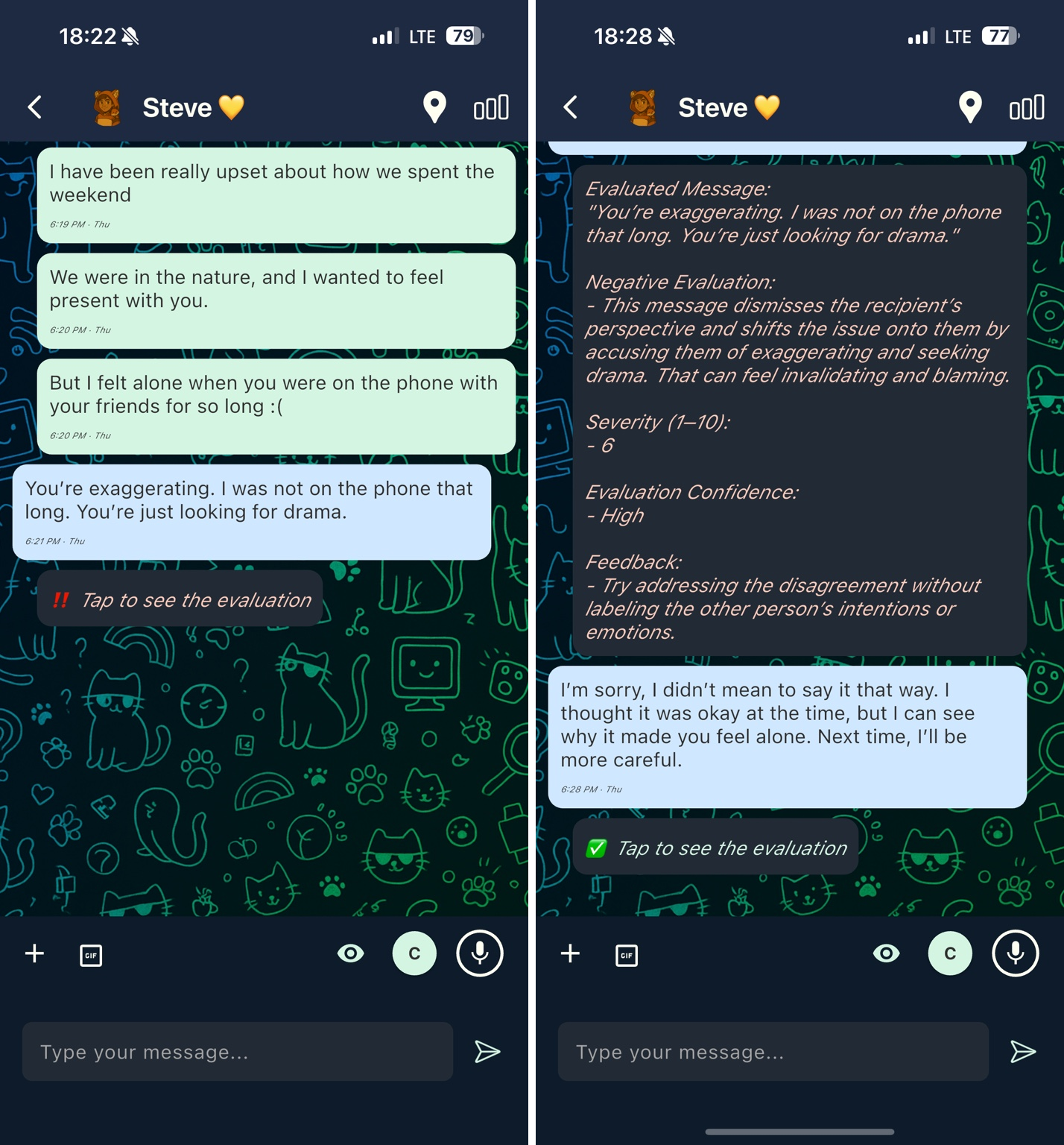
Communicat’s real-time message evaluation highlights a dismissive reply, helping interrupt the pattern before the conversation escalates and creating space for an apology and a better response.
He Paused, Read It, and Sent a Different Message
He read the evaluation.
Then there was a silence that felt very different from the kind that usually comes before a bigger fight.
A minute later, he sent another message.
“I’m sorry, I didn’t mean to say it that way. I thought it was okay at the time, but I can see why it made you feel alone. Next time, I’ll be more careful.”
It was not a perfect message.
It was not poetic. It was not some huge dramatic breakthrough.
But it was different in the exact way that mattered.
He was no longer arguing with my feelings. He was responding to them.
He was no longer telling me who I was being. He was actually acknowledging what I experienced.
And that changed everything.
The Biggest Difference Was the Fight That Never Happened
What stayed with me most was not just that he apologized.
It was what did not happen after.
I did not have to spend the next forty minutes proving I was not dramatic.
I did not have to explain why feeling lonely on a couple’s trip would hurt.
I did not have to get dragged into one of those exhausting side arguments where the original issue disappears and all that is left is tone, intention, memory, and blame.
The conversation changed direction before it hardened.
That was the real gift of it.
Not winning. Not being told I was right. Just not having to fight so hard to be understood in the first place.
Why This Moment Felt So Different
He did not become a different person overnight.
I did not become a different person overnight either.
But something important happened in that exchange. There was a pause between reaction and escalation. And inside that pause, there was enough space for reflection.
That is what felt different.
So many relationship arguments get worse because neither person stops the momentum early enough. Someone feels hurt. Someone gets defensive. Then both people start reacting to the reaction instead of the original feeling.
This time, the evaluation interrupted that.
It made the message visible for what it was before I replied from anger and before he doubled down from defensiveness.
And because of that, the conversation stayed repairable.
That is what I remember most from that weekend.
Not the call. Not even the first message.
The moment I thought, “Here we go again,” and then, for once, we did not.
I just hope that the pattern will not repeat itself again.
Another Note From Communicat
Stories like this are not about declaring one person the winner and the other the problem.
They are about seeing a moment more clearly.
A lot of people turn to Communicat not because they are trying to end something, but because they are trying to understand it while it is happening.
Sometimes a calm, neutral reflection of the message is enough to slow things down before defensiveness takes over.
Not to make the conflict bigger.
Just to make the conversation easier to see for what it is.
