
Human-Centered AI - Part 3: How AI Can Improve Communication Before Conflict Escalates
Exploring human blind spots in communication, repeated conflict patterns in relationships, and how human-centered AI can identify negative messages before they spiral into fights
In Part 2, we looked at what human-centered AI can look like in practice. In Part 3, we turn to communication, one of the most emotional and pattern-filled parts of human life, and explore how AI can help people notice harmful patterns before they spiral.
Why communication is such a difficult human problem
Communication can feel like a side character until you are inside a real conversation with real emotions attached to it. Then it suddenly becomes the main character.
Most people do not wake up planning to communicate badly. They are trying to explain themselves. They are trying to be understood. They are trying to respond to something that hurt, disappointed, frustrated, or overwhelmed them. But communication is one of those strange parts of life where intention and impact can separate in seconds.
A message can feel honest to the sender and harsh to the receiver. A short reply can feel efficient to one person and cold to the other. A sentence written in frustration can land like disrespect, even if that was never the goal.
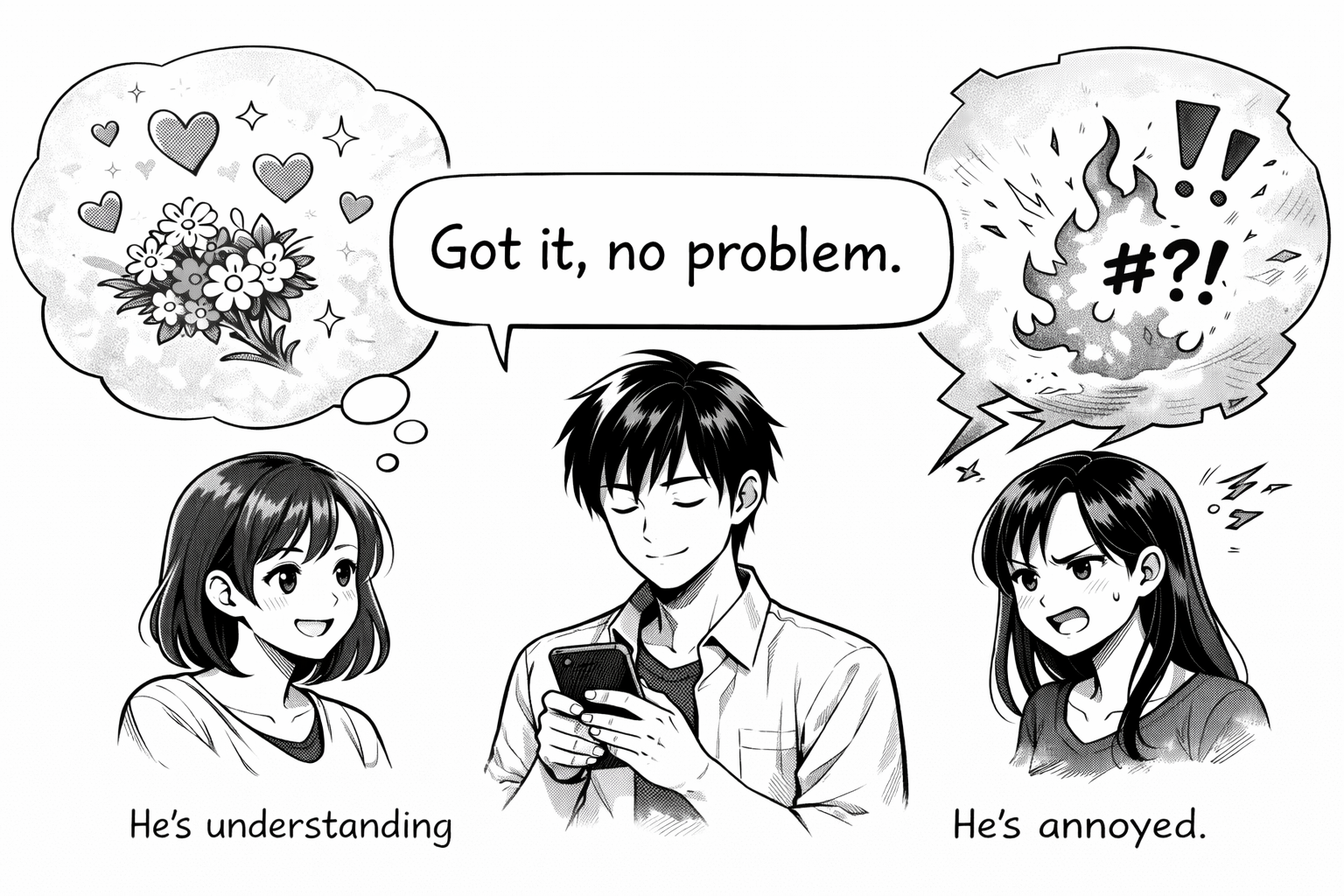
A single message can be received in very different ways depending on tone, context, and emotion. This black and white anime illustration highlights how even a phrase like “Got it, no problem.” can feel warm to one person and irritated to another, revealing why communication misunderstandings happen so easily.
That is part of what makes communication so difficult. It happens quickly. It happens emotionally. And unlike a carefully revised essay or a speech practiced in your head, real communication usually happens when people are tired, stressed, hurt, jealous, defensive, or already halfway into an argument.
Sometimes a fight does not begin with some major betrayal or cinematic moment. Sometimes it begins with a badly timed sentence, a sharp tone, a phrase that feels dismissive, or a message that lands harder than the sender realizes. Then the other person reacts to the feeling of the message, not just its content. Then the sender reacts to that reaction. Then both people stop trying to understand and start trying to protect themselves.
That is where things begin to spiral.
Human Blind Spots in Messages and Tone
One of the hardest things for any of us is seeing our own communication patterns while we are in the middle of them.
It is much easier to notice someone else being passive aggressive, defensive, dismissive, or unfair than it is to notice ourselves doing it. In our own minds, we usually have context. We know what we meant. We know what happened before the message. We know the emotion behind the wording. So when we look at our own communication, we tend to see intention first.
The other person does not receive intention. They receive the words, the tone, the timing, and the emotional weight.
That gap creates blind spots.
A person can think they are being direct when they are actually being harsh. They can think they are setting a boundary when they are really punishing. They can think they are being rational while their words are quietly escalating the situation. They can send something like “Fine” or “Do whatever you want” and not fully register how much resentment, distance, or contempt the other person may hear in it.
We have all had some version of that moment where we look back at a message and think, that sounded worse than I meant it.
The problem is that in real life, that realization often comes later. By then, the other person may already be hurt, defensive, or angry.
Why Relationship Fights Repeat the Same Patterns
This becomes even more obvious in romantic relationships.
Couples often think they are fighting about different things every time. One day it is about chores. Another day it is about texting. Another day it is about lateness, family, effort, jealousy, tone, or who forgot what. On the surface, the subject changes.
But very often, the deeper pattern does not.
One person feels unheard. The other feels attacked. One reaches with frustration. The other shuts down. One gets sharper. The other gets colder. One pushes harder. The other becomes more defensive. Different argument, same emotional loop.
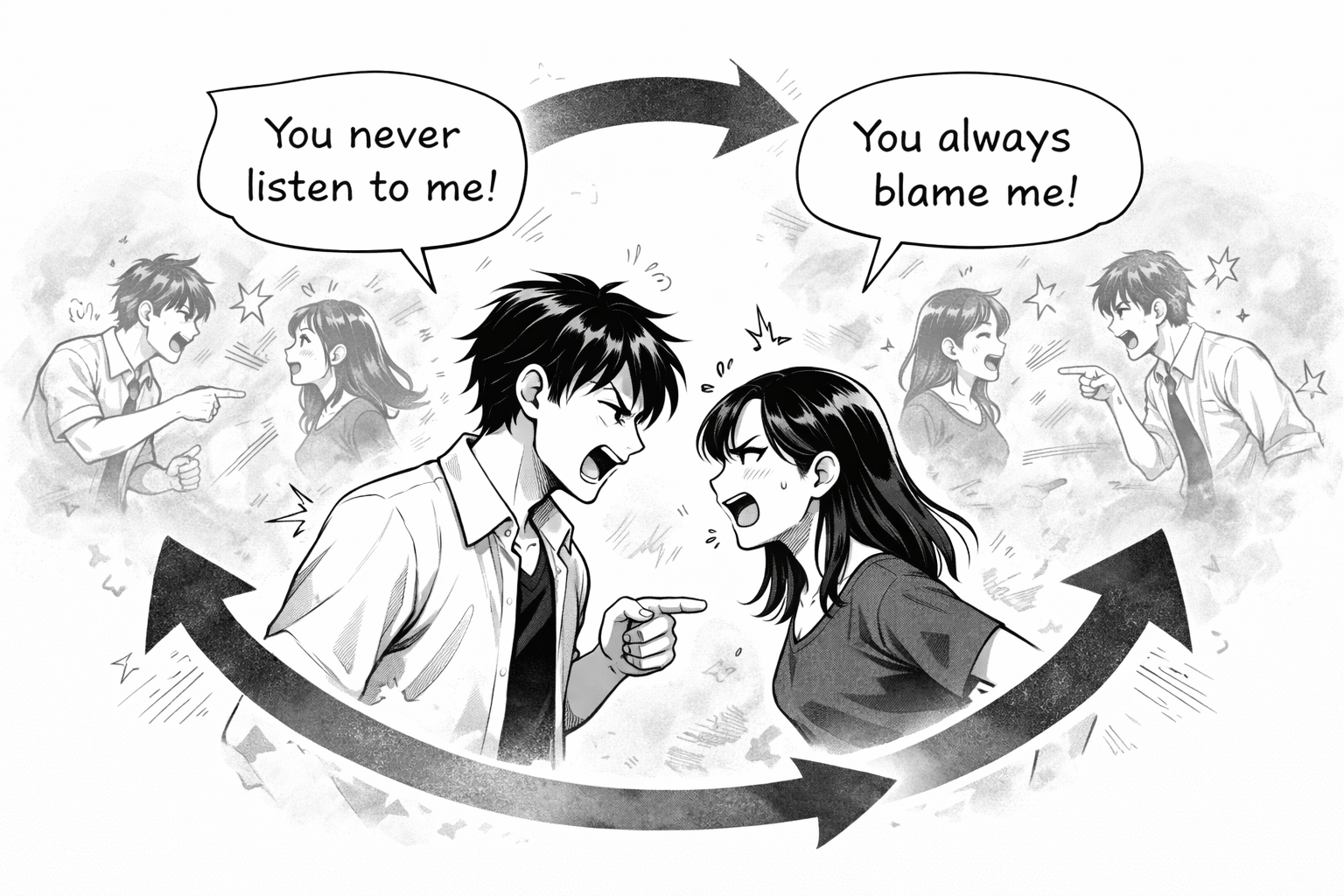
Many relationship fights are not just about the topic in front of the couple. They repeat the same emotional loop of blame, defensiveness, and feeling unheard, which is why the pattern often matters more than the subject itself.
That is one reason so many couples say some version of, “We keep having the same fight.”
In couples therapy, one of the most important early discoveries is often not the subject of the fight, but the pattern underneath it. The topic matters, of course. But repeated relationship damage usually comes from the way people speak to each other, react to each other, defend themselves against each other, and trigger each other over time.
That is the real pattern.
It is the difference between arguing about dishes and repeating a cycle where one person feels abandoned and the other feels controlled. It is the difference between one irritated text and a recurring loop where both people start bracing for impact the moment conflict begins.
This is why so many fights feel bigger than the original issue. The issue may be small. The pattern is not.
If you have ever been in a relationship where every argument somehow started sounding like a sequel, just with a different setting, you already know this feeling. Different topic, same emotional script.
Why Communication Is a Powerful Use Case for Human-Centered AI
This is exactly why communication is such a meaningful place for human-centered AI.
Language leaves patterns behind. Tone leaves patterns behind. Repeated defensiveness, blame, contempt, passive aggression, stonewalling, and escalation all leave traces in wording. Not perfect traces. Not magical traces. But traces that can be noticed.
And unlike emotions in the abstract, messages can actually be looked at.
People already do this all the time with each other. They send screenshots to friends and ask, “Does this sound rude?” They ask therapists, “Was I wrong to say that?” They reread old arguments trying to figure out where everything went sideways. They look for outside perspective after the fact because inside the moment, perspective is hard.
That is where human-centered AI can genuinely help.
Not by taking over the conversation. Not by becoming the authority on human relationships. Not by turning into some robotic referee handing out moral verdicts like a strict school principal in a sci-fi remake.
By acting like a mirror.
A good communication tool can notice patterns the sender may not notice in the moment. It can point out when a message sounds blaming, contemptuous, dismissive, or emotionally loaded. It can show why a sentence may land badly. It can create a pause between impulse and escalation.
And that pause matters more than it sounds.
Because so many fights do not begin when two people calmly sit down to discuss a problem. They begin when one person sends a message that offends, provokes, corners, or wounds the other. Then the receiver gets triggered or defensive. Then the sender feels misunderstood and defends their own wording. Then the whole conversation hardens.
Once both people are activated, understanding gets much harder.
The most useful role for AI in communication is not to write for you. It is to catch the moment right before the spiral deepens.
How Communicat Helps Prevent Negative Messages From Turning Into Fights
This is exactly the kind of moment Communicat is built for.
Communicat is built around a simple idea: sometimes the biggest damage in a fight happens right after one negative message lands.
That is the moment it focuses on.
Communicat helps by catching negative communication in a message before it has the chance to spiral into a bigger fight. It steps in right after a negative message is sent and identifies the pattern in that message and why it may feel bad to the other person. It does not just say that something is negative. It points to what is happening in the wording. Maybe the message sounds blaming. Maybe it feels dismissive. Maybe it carries contempt. Maybe it corners the other person. Maybe it turns frustration into accusation.

An illustration built around a real Communicat screenshot. Communicat is an AI communication app that identifies negative communication in messages, explains why a message may feel harmful, and helps create room for reflection, rephrasing, or apology before a fight escalates.
That reflection matters because, in the middle of conflict, people often do not see what is wrong with their own message. They only see what they meant, or what they were reacting to.
Communicat creates room before things get worse.
It gives the sender a chance to understand why the message may trigger the other person. It gives room for clearer communication, an apology where necessary, and better understanding before both sides get defensive and start reacting from hurt. It creates a chance to rephrase before the other person absorbs the full impact of the message and responds from that wound.
That is the core value.
Not perfection.
Not policing.
Not some fantasy of never saying the wrong thing.
Awareness before escalation.
A lot of relationship fights start when one person feels offended by the wording of the other and reacts defensively, sometimes with temper, sometimes with distance, sometimes with their own sharp words. Communicat is designed to interrupt that exact pattern early enough that the receiver does not have to immediately react to the sting of the message. It gives the sender a chance to understand what is wrong with the message and either rephrase it or apologize before the conversation locks into self-protection.
That may sound small from the outside. In real relationships, it can be the difference between a tense moment and a full fight.
Because once two people get defensive, the conversation usually stops being about understanding and starts being about survival.
Communicat is not there to replace human judgment. It is there to support it at the exact moment when judgment is easiest to lose.
If Part 2 was about AI helping experts notice patterns in medicine and science, this is the communication version of the same principle. A second layer of awareness. A mirror held up at the right moment. A chance to catch the pattern before the pattern takes over.
A Better Future for Communication and Relationships
The goal is not to create perfect communicators.
No one is perfectly regulated all the time. No one speaks flawlessly in every emotional moment. No healthy relationship is built on never misfiring. Human beings are messy. That is part of being human.
The real goal is more awareness.
More moments where someone catches themselves before making things worse. More moments where a defensive reply becomes a clearer one. More moments where a hurtful phrase becomes an honest one. More moments where apology arrives before escalation hardens into another painful loop.
That is a meaningful use of AI.
Not making people less human, but helping them stay more connected to the part of themselves that wants to communicate better in the first place.
If human-centered AI is going to matter anywhere, it should matter in the places where awareness can protect something real. A relationship. A conversation. A moment that could have become another avoidable fight, but did not.
Better communication does not solve everything. But it changes a lot.
Sometimes the most important intervention is not after the fight. It is the message right before it.
